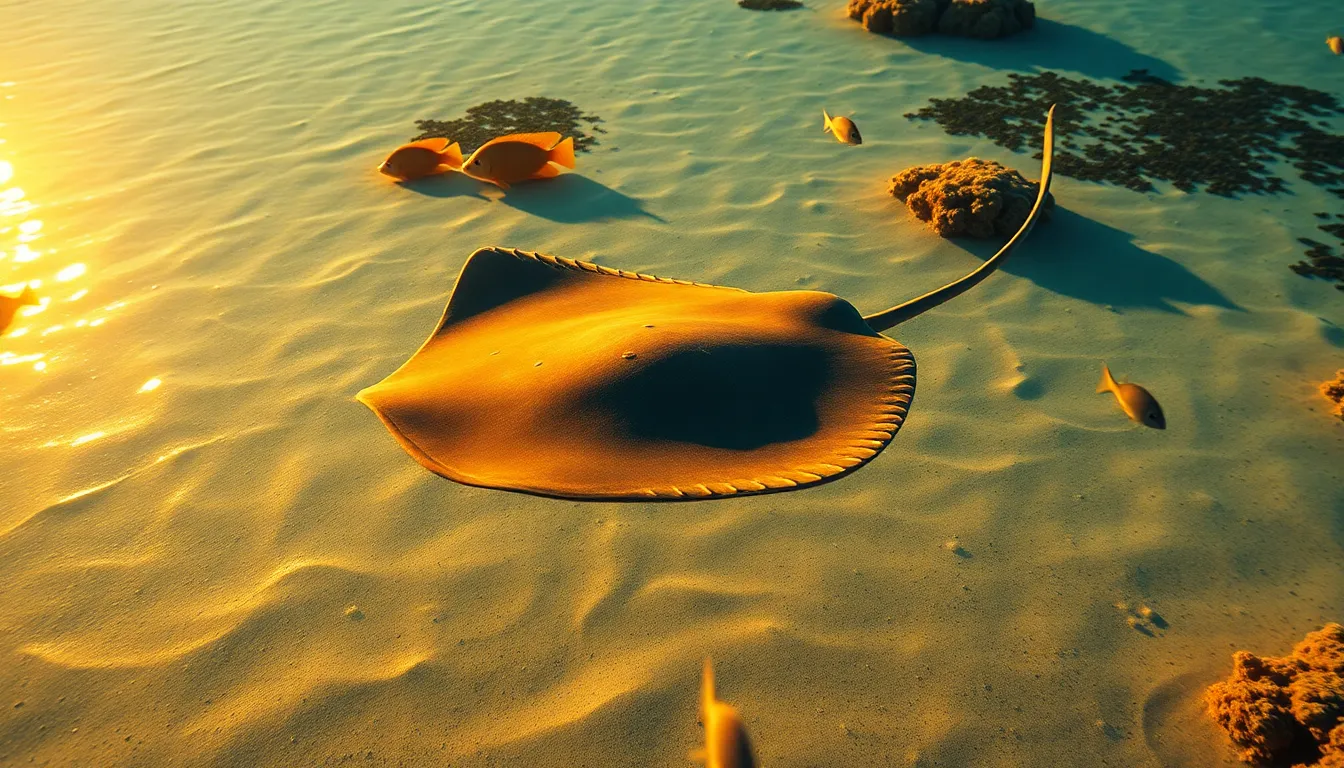
The ray, belonging to thegenus Raja, is a cartilaginous fish found in both marine and freshwater. This genus includes several species, each with unique characteristics. Rays are commonly known assea raysor simplyrays. In taxonomic terms, they belong to the classChondrichthyes, which also includes sharks and other species of cartilaginous fish.
Physical description and identification markers
Rays are easily recognizable due to their flattened shape and broad bodies. They have a flat back and a long tail that often features spines or venomous stingers. The coloration varies by species, but they generally display shades ranging from brown to gray, with patterns that help them camouflage against the sea floor. Therayshave gills located on the underside of their bodies and eyes on the top.
Main characteristics
- Body: Flattened and disc-shaped.
- Tail: Long and often with spines or stingers.
- Coloration: Varies among species; generally brown or gray tones.
- Size: Varies by species, from small individuals to large rays that can exceed 2 meters in length.
Size range and record specimens
The dimensions of rays vary considerably among the different species of the genus Raja. Some of the smaller ones can measure around 60 centimeters, while the largest, such as thethorny ray, can reach lengths of up to 2.5 meters. A record specimen of thelongtail raywas captured in the North Atlantic, measuring 2.3 meters and weighing over 100 kilograms.
Habitat distribution and depth ranges
Rays are found in various marine habitats, from shallow coastal waters to depths of over 200 meters. They prefer sandy or muddy bottoms where they can bury themselves to camouflage from predators and hunters. They are distributed throughout the Atlantic and Pacific Oceans, as well as the Mediterranean Sea.
Habitat distribution and depth range table
| Species | Habitat | Depth range (meters) |
|---|---|---|
| Thorny ray | Coastal waters | 0 – 100 |
| Longtail ray | Deep waters | 50 – 200 |
Seasonal behavior and migration patterns
Rays are generally migratory, moving to deeper waters during the warmer months and returning to coastal areas in the fall. Their migration patterns are influenced by water temperature and food availability. During the breeding season, rays form groups and move to specific areas to mate.
Seasonal behavior patterns
- Spring: Migration to warmer waters.
- Summer: High activity in coastal areas.
- Fall: Return to deep waters.
- Winter: Less activity, they hide on the bottom.
Level of difficulty in spearfishing and techniques
Fishing for rays can be challenging due to their behavior and habitat. They are considered mediumdifficultyfor spearfishing. The key lies in patience and the right technique. Solo fishing or small group fishing is recommended to increase the chances of success.
Recommended techniques
- Camouflage: Use wetsuits in colors that blend with the seabed.
- Stay alert: Observe the movements of the rays on the bottom.
- Use of spear: A flat-headed spear is recommended to avoid damaging the fish’s body.
Best hunting methods and equipment recommendations
For ray fishing, the right equipment is essential. It is recommended to use ahigh-quality spear,preferably one that allows for a good safety distance. Additionally, using aweight beltcan help reach the depths where these species are usually found.
Equipment recommendations
- Spear: Preferably 90 to 120 cm.
- Mask and snorkel: For good visibility underwater.
- Wetsuit: To protect against the cold and for camouflage.
Culinary applications and preparation methods
Rays are valued in gastronomy for their white, tender meat. They can be prepared in various ways, with the most common being grilled, baked, or in stews. Ray meat can be marinated to enhance its flavor and is recommended to be served with light sauces.
Preparation methods
- Grilled: Ideal for highlighting the natural flavor of the meat.
- In stews: Combined with vegetables and spices for a comforting dish.
Regulatory status and size limits by region
Ray fishing is subject to regulations that vary by region. In some areas, there is a minimum size limit for capture, while in others, fishing for certain species is completely prohibited to protect their populations. It is important to consult local regulations before going fishing.
Conservation status and sustainability notes
The conservation status of rays varies by species; some are classified as vulnerable due to overfishing and habitat degradation. Conservation efforts are being implemented to protect ray populations and ensure their long-term sustainability. It is crucial for fishermen to adopt responsible practices and follow established regulations.
Conservation status alerts
- Vulnerable species: Some species of rays are endangered due to overfishing.
- Sustainable practices: Selective fishing and respect for established limits are recommended.