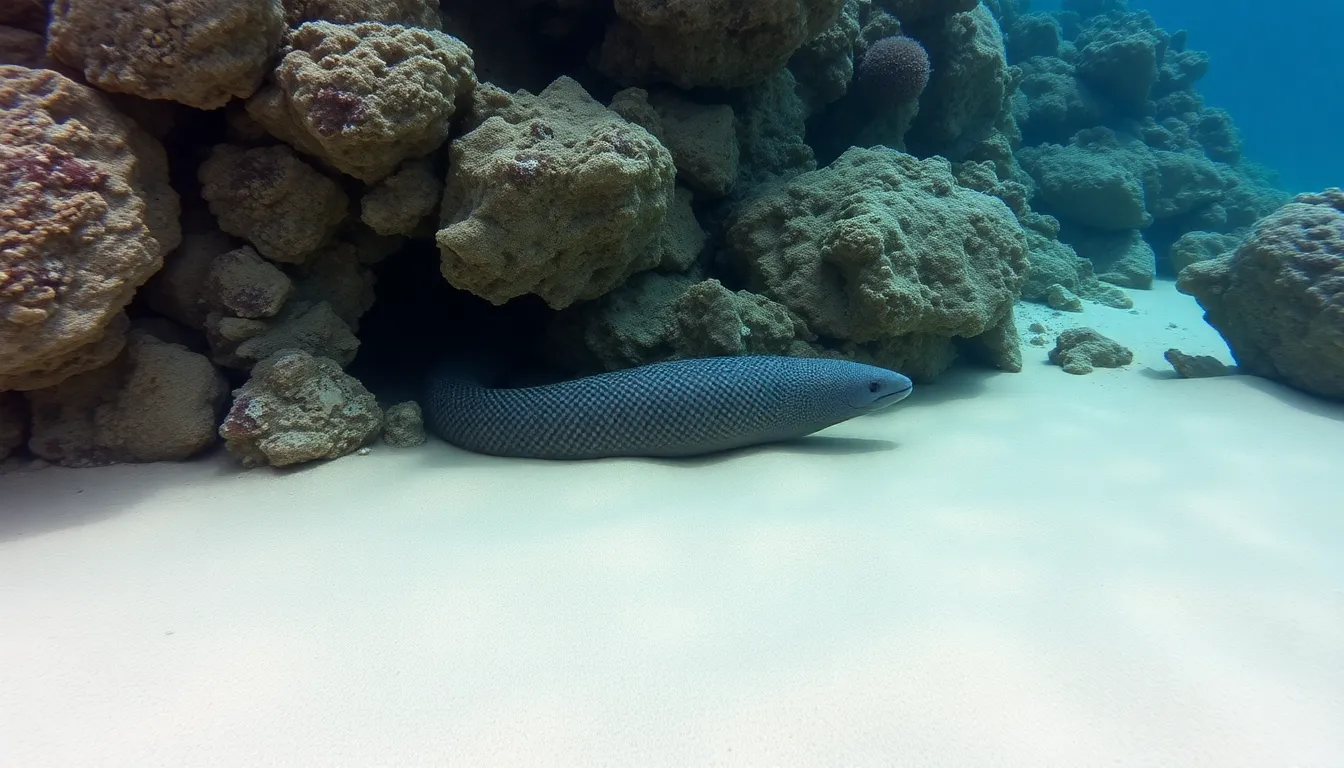
The moray eel, scientifically known asMuraena helena, belongs to the family Muraenidae and is a fish of the order Anguilliformes. This fish is commonly known by various names in different regions, including “common moray” and “European moray.” Its taxonomic classification is detailed below:
- Kingdom: Animalia
- Phylum: Chordata
- Class: Actinopterygii
- Order: Anguilliformes
- Family: Muraenidae
- Genus: Muraena
- Species: Muraena helena
Physical description and identification markers
The moray eel has an elongated, serpentine body that can reach lengths of up to 2.5 meters. Its skin is smooth, scale-less, and covered with a slippery mucus that provides protection and facilitates its movement in the water. Colors can vary from green and brown tones to darker patterns, allowing it to camouflage in its natural environment.
Among the most notable identification markers are:
- The elongated, cylindrical body that tapers towards the tail.
- The dorsal and anal fins that extend along the back of the body.
- A large head with prominent jaws and sharp teeth.
Size range and record specimens
Moray eels can vary significantly in size. Generally, adults measure between 0.5 and 1.5 meters, although specimens over 2 meters have been recorded. A notable specimen was captured off the coast of France, measuring approximately 2.3 meters and weighing over 30 kg, making it one of the largest documented specimens of this species.
Habitat distribution and depth ranges
The moray eel is found in coastal waters of the Mediterranean Sea and the Atlantic Ocean, from the coasts of Norway to those of Senegal. It prefers rocky habitats, reefs, and sandy bottoms where it can hide among crevices and cavities. Its depth range varies from 5 to 50 meters, although they have been sighted at greater depths in some locations.
| Location | Depth (m) | Habitat type |
|---|---|---|
| Mediterranean Sea | 5-50 | Rocks and reefs |
| Atlantic Ocean | 10-40 | Sandy and rocky bottom |
Seasonal behavior and migration patterns
Moray eels tend to be more active during spring and summer when water temperatures are warmer. During winter, many moray eels decrease their activity and may take refuge in cracks or caves to conserve energy. In terms of migration, they are resident fish that, although they do not undertake long migrations, may move within their habitat in search of food or more favorable conditions.
Seasonal behavior patterns are marked by changes in water temperature and prey availability, affecting their hunting activity.
Difficulty level in spearfishing and techniques
Spearfishing for moray eels presents a moderate to high level of difficulty, mainly due to their cautious behavior and ability to hide in holes and crevices. Spearfishers must be patient and prepared to wait for the right moment to shoot.
The most effective techniques include:
- Use of lures: Fishers can use lures that mimic their natural prey.
- Holding breath: It is crucial to remain still and silent to avoid startling the moray eel.
- Waiting in strategic spots: Identify areas where moray eels are known to inhabit and wait for them to approach.
Best hunting methods and equipment recommendations
To effectively hunt morays, it is recommended to use a suitable speargun, preferably one with higher power to ensure a clean shot. It is also advisable to wear a wetsuit that provides both protection and camouflage. Below are some recommended equipment:
- Speargun: A speargun with a power of at least 90 cm is ideal for reaching morays.
- Harpoon: In areas where morays are more cautious, a harpoon can be more effective.
- Flashlight: Useful for exploring dark caves where morays often hide.
Culinary applications and preparation methods
The moray is a highly valued fish in Mediterranean cuisine. Its flesh is firm and has a delicate flavor that makes it ideal for various preparations. Among the most common culinary applications are:
- Grilled: The moray can be grilled with herbs and spices to enhance its natural flavor.
- Stew: It is also used in stews where it is combined with other seafood and vegetables.
- Sushi: In some cultures, the moray is used in sushi preparation, although it must be handled carefully due to its texture.
Regulatory status and size limits by region
The regulatory status of the moray varies considerably between different regions. It is important for fishermen to be aware of local regulations, which may include size limits and catch quotas to help conserve populations.
- European Union: In general, it is recommended not to catch morays smaller than 70 cm.
- Spain: Regulations may vary by autonomous community, so it is essential to consult local legislation.
Conservation status and sustainability notes
The moray is not currently considered an endangered species, but its population may be affected by overfishing and habitat degradation. It is crucial for fishermen to practice sustainable fishing, respecting regulations and limiting the capture of young specimens to ensure the health of future populations.
Additionally, fishermen are encouraged to participate in conservation and species monitoring programs to contribute to the health of the marine ecosystem.
In conclusion, theMoray (Muraena helena)is a fascinating species that offers both challenges and rewards for underwater fishermen. With the right knowledge and a responsible approach, it is possible to enjoy this species while protecting its future in our oceans.