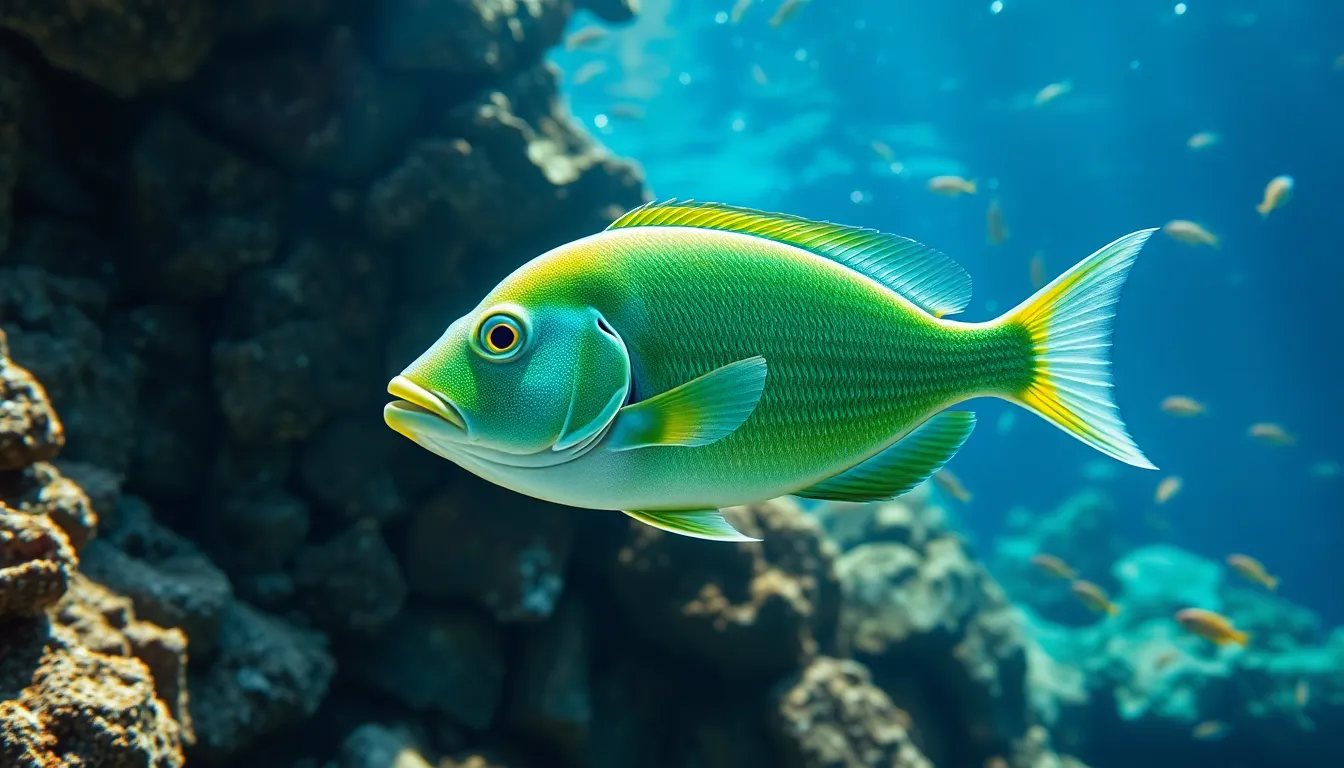
TheMaragota(Labrus bergylta) belongs to the wrasse family, a group of fish characterized by their robust bodies and behavior generally associated with rocky habitats. This species is known in different regions aslabrus,dogfish, and in some English-speaking areas asballan wrasse.
Physical description and identification markers
The Maragota has an elongated oval body with smooth skin covered in small scales. Its coloration varies from bright green to blue and brown, allowing it to effectively camouflage among rocks and underwater vegetation. One of the main identification markers is the shape of its head, which is more prominent in males, and the dorsal fins that are long and continuous.
Distinctive characteristics
- Size: Males can reach up to 70 cm in length, while females are generally smaller.
- Coloration: Varies depending on the environment, but males usually have more vibrant colors.
- Jaw shape: The lower jaw is more prominent in males, making identification easier.
Size ranges and record specimens
The Maragota can reach considerable sizes, with specimens exceeding 10 kg. The documented catch record is around 15 kg, making it an attractive target for spearfishers.
Habitat distribution and depth ranges
The Maragota is primarily found in the waters of the northeastern Atlantic, from Norway to the Canary Islands. It prefers rocky bottoms and posidonia meadows, where it can find shelter and food. It has been documented to inhabit depths ranging from 1 to 50 meters, although it can occasionally be found in deeper waters.
Habitat and depth table
| Region | Depth (m) |
|---|---|
| Northeastern Atlantic | 1 – 50 |
| Canary Islands | 1 – 30 |
Seasonal behavior and migration patterns
The Maragota exhibits notable seasonal behavior. During the summer, they gather in large numbers, making them easier to catch. In winter, they tend to disperse and can be more difficult to locate. These seasonal migrations are influenced by water temperature and food availability.
Seasonal behavior patterns
- Spring: They feed in shallow areas and begin reproduction.
- Summer: They gather, increasing the chances of capture.
- Autumn: They begin to disperse to deeper waters.
- Winter: They become more solitary and harder to find.
Difficulty level of spearfishing and techniques
Fishing for the Maragota is considered medium to high difficulty, depending on the fisher’s experience. Its ability to camouflage and evasive behavior can present a challenge. Recommended techniques include using spearguns and apnea techniques to stealthily approach these fish.
Recommended techniques
- Apnea: Ideal for silent approaches.
- Spearguns: Recommended for long-distance capture.
- Camouflage: Use wetsuits that mimic the underwater environment.
Better hunting methods and equipment recommendations
For a successful catch of the Maragota, it is essential to have the right equipment. Fishermen should opt for medium-length spearguns and harpoons with sharp tips. Additionally, the use of diving goggles with good visibility and fins that facilitate movement in the water is recommended.
Equipment recommendations
- Speargun: 75-100 cm for a balance between accuracy and range.
- Wetsuit: 5 mm for protection and camouflage.
- Diving goggles: With anti-fog lenses for better visibility.
Culinary applications and preparation methods
The Maragota is valued not only for its fishing challenge but also for its gastronomic worth. Its flesh is firm and has a delicate flavor, making it an excellent choice for various preparations.
Preparation methods
- Grilled: Ideal for highlighting its natural flavor.
- In ceviche: Perfect for enjoying its freshness.
- In stews: Its meat remains juicy and flavorful.
Regulatory status and size limits by region
The regulation of Maragota fishing varies by region. In many areas, there are size limits and catch quotas to preserve the population. It is crucial for fishermen to be informed about local regulations before going fishing.
Size limits
- Europe: Minimum catch size of 30 cm.
- Canary Islands: Minimum catch size of 25 cm.
Conservation status and sustainability notes
The Maragota has been a concern regarding its conservation due to overfishing in some areas. It is important for fishermen to practice sustainable fishing to ensure the availability of this species in the future.
Conservation status alerts
- Overfishing: Reports of decline in certain areas of the Atlantic.
- Sustainable fishing: Promote responsible catch practices.