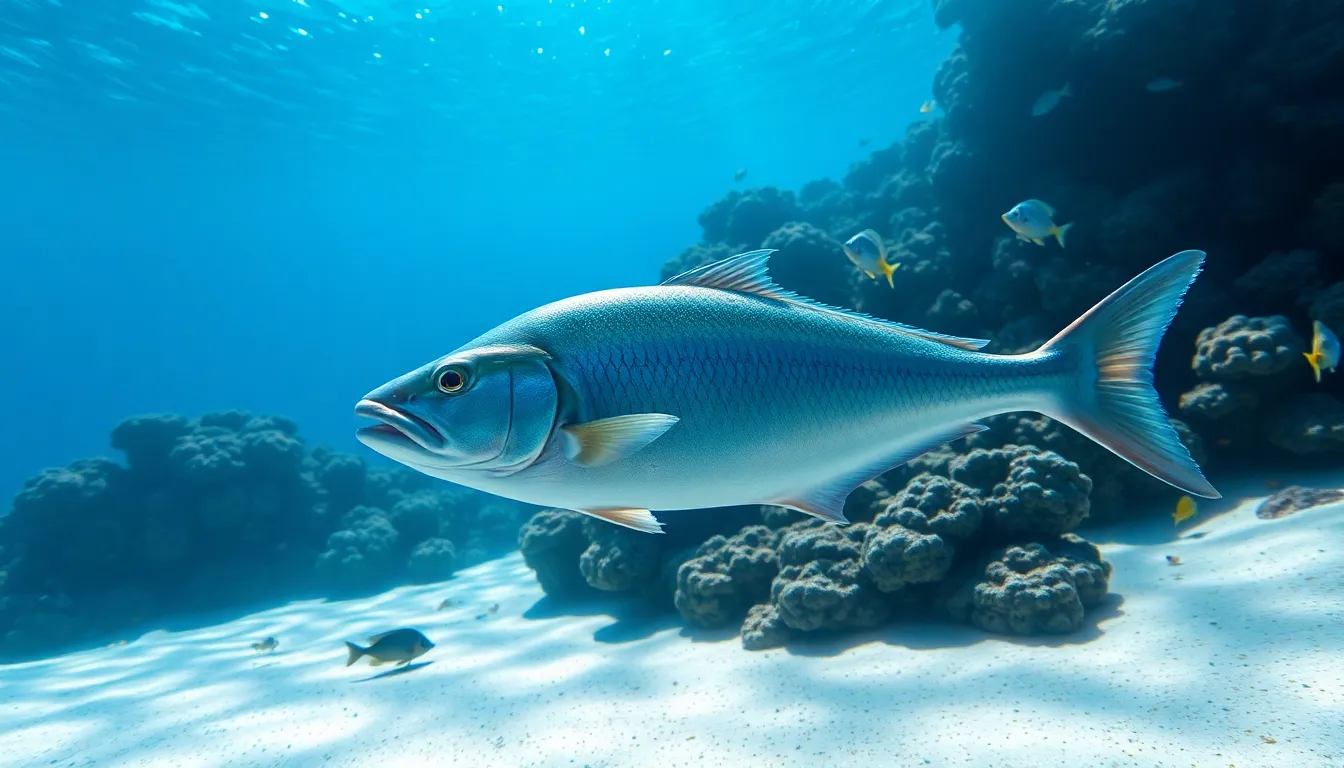
Thecommon jack(Caranx hippos) belongs to the family Carangidae, which includes various species of fish that are of great importance in commercial and recreational fishing. Below is a brief taxonomic classification:
- Kingdom: Animalia
- Phylum: Chordata
- Class: Actinopterygii
- Order: Carangiformes
- Family: Carangidae
- Genus: Caranx
- Species: Caranx hippos
Among the common names for this species arejack,jurelita, andgolden jack, depending on the region in which it is found.
Physical description and identification markers
The common jack is a fusiform, robust, and elongated fish that exhibits distinctive characteristics. Its dorsal coloration is bluish-green, while the flanks are silver, allowing it to effectively camouflage in its environment.
Identification characteristics
- Scales: The skin of the common jack is covered with small, cycloid scales.
- Fins: It has long, pointed dorsal and anal fins, with a black edge on the dorsal fin.
- Eyes: Its eyes are large, allowing for excellent underwater vision.
Sizes and record specimens
The size of the common jack varies significantly, with individuals reaching lengths of up to 1.5 meters and weights of up to 60 kilograms. However, most specimens found in spearfishing typically measure between 60 and 90 centimeters.
The world record for catching a common jack is 62 kg, set by an angler in 2003.
Habitat distribution and depth ranges
The common jack is found in warm and temperate waters of the Atlantic, Pacific, and Indian Oceans. Its preferred habitat includes coral reefs, coastal areas, and continental shelves.
Habitat and depth distribution table
| Region | Depth (m) |
|---|---|
| Atlantic Ocean | 0-100 m |
| Pacific Ocean | 0-150 m |
| Indian Ocean | 0-200 m |
Seasonal behavior and migratory patterns
Common jacks are migratory fish that move in schools. Their seasonal behavior is influenced by factors such as water temperature and food availability.
Seasonal behavior patterns
- Spring: An increase in feeding activity is observed, especially in coastal waters.
- Summer: They migrate to deeper waters in search of cooler temperatures.
- Autumn: They return to coastal areas to spawn.
- Winter: Activity decreases, and jacks usually remain in deeper waters.
Difficulty level for spearfishing and techniques
Common jack fishing presents a moderate to high level of difficulty due to their speed and agility. For spearfishers, having good free diving technique and suitable equipment is crucial.
Recommended techniques
- Camouflage: Use wetsuits in colors that blend with the environment.
- Waiting: Wait in areas where they usually feed.
- Use of lures: Use lures that mimic the movement of their natural prey.
Best hunting methods and equipment recommendations
For effective common jack fishing, it is essential to have the right equipment and apply the best hunting practices.
Equipment recommendations
- Speargun: A speargun of at least 90 cm in length is ideal.
- Mask and snorkel: Equipment that offers good visibility and comfort.
- Wetsuit: A wetsuit suitable for the water temperature.
Culinary applications and preparation methods
The common jack is a highly valued fish in gastronomy due to its firm flesh and delicious flavor. It is ideal for various preparations, from grilling to ceviches.
Recommended preparation methods
- Grilled: Marinated with lemon and spices, then grilled.
- Ceviche: Cut into cubes and marinated with lemon juice, onion, and cilantro.
- Soups and stews: Used as a main ingredient in hot dishes.
Regulatory status and size limits by region
The common jack is subject to fishing regulations that vary by region. It is vital for fishermen to know local laws to ensure the sustainability of the species.
Recommended size limits
- Atlantic: Minimum size of 60 cm.
- Pacific: Minimum size of 70 cm.
- Indian: Minimum size of 65 cm.
Conservation status and sustainability notes
The common jack is considered a species of least concern, although some populations are threatened by overfishing and habitat degradation.
Conservation status alerts
- Overfishing: It is essential to avoid excessive capture to allow for the recovery of populations.
- Habitat protection: Maintain and protect coral reefs and spawning areas.
Fishermen must adopt responsible practices to ensure the sustainability of the common mackerel and the health of marine ecosystems.