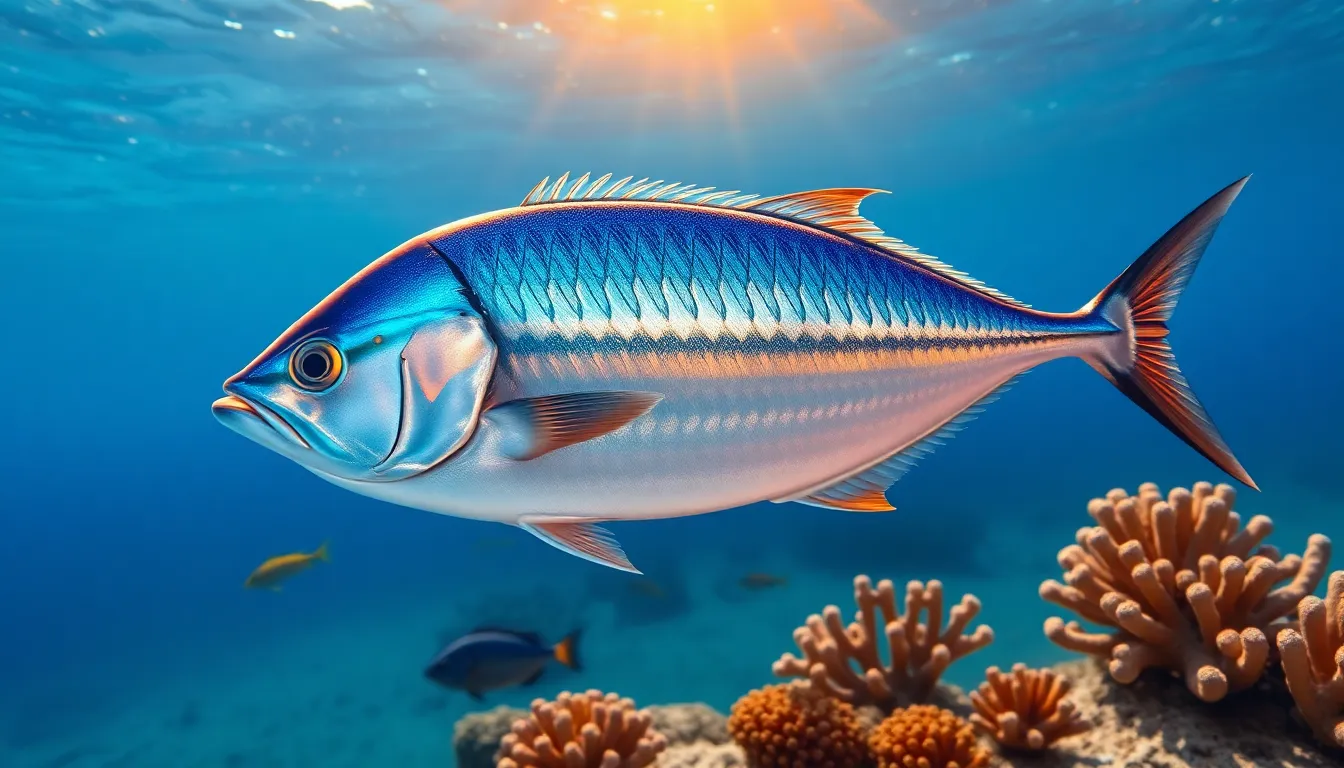
TheAlbacore(Katsuwonus pelamis) belongs to the family Scombridae, which includes other fish such as tuna and swordfish. This species is known by various common names, depending on the region, such asalbacore, skipjack tunaandshortfin fish. Its taxonomic classification is as follows:
- Kingdom: Animalia
- Phylum: Chordata
- Class: Actinopterygii
- Order: Scombriformes
- Family: Scombridae
- Genus: Katsuwonus
- Species: K. pelamis
Physical description and identification markers
The Albacore is a fish with an elongated, fusiform body that exhibits a characteristic coloration. Its back is dark blue, while the sides are silver with vertical lines that may be visible. This coloration is not only beautiful but also serves as camouflage in the water.
Distinctive features include:
- Two dorsal fins, the first taller than the second.
- A well-defined lateral line running along its body.
- A prominent jaw with numerous small teeth.
Size ranges and record specimens
The size of the Albacore can vary, although it generally reaches lengths of between 60 and 80 cm. Specimens have been recorded reaching up to 1.2 meters in length and weighing 40 kg. These size ranges are important for determining its maturity and the best time for fishing.
Habitat distribution and depth ranges
The Albacore is found in tropical and subtropical waters of all oceans, being more common in the Pacific Ocean and the Indian Ocean. It prefers warm waters and can be found at depths ranging from the surface to 200 meters.
| Region | Depth (m) |
|---|---|
| Atlantic Ocean | 0 – 200 |
| Pacific Ocean | 0 – 150 |
| Indian Ocean | 0 – 100 |
Seasonal behavior and migratory patterns
The Albacore exhibits migratory behavior marked by water temperature and food availability. During the warmer months, it tends to move closer to the coast in search of schools of small fish, while in winter it moves away to deeper waters. These patterns are crucial for underwater fishermen, as knowledge of migration can determine the right time for fishing.
- Spring: An increase in activity near the coast is observed.
- Summer: Greater presence in warm waters and abundance of food.
- Autumn: Migration towards deeper waters begins.
- Winter: They are found in colder and deeper waters.
Difficulty level for spearfishing and techniques
The fishing of the Albacore can be considered of moderate to high difficulty, depending on the experience of the fisherman. Its speed and agility require proper techniques to be captured. Some of the recommended techniques include:
- Surface fishing: Using a speargun and stalking techniques.
- Deep fishing: Especially during the migration season, using dead fish as bait.
It is advisable to have appropriate equipment and to know the fishing area well to increase the chances of success.
Best hunting methods and equipment recommendations
For Albacore fishing, it is suggested to use:
- Spearguns: Equipment between 75 and 100 cm is ideal for this species.
- Fins and wetsuit: To facilitate movement in the water and maintain body temperature.
- Masks and snorkels: Of good quality to ensure clear vision underwater.
Hunting techniques should focus on observing their behavior and movements to maximize capture opportunities.
Culinary applications and preparation methods
Albacore is highly valued in gastronomy, especially in Japanese cuisine, where it is used to prepare sushi and sashimi. Its meat is rich in omega-3 and has a characteristic flavor that makes it a versatile ingredient. Some of the most common preparation methods include:
- Grilled: Marinating and grilling to enhance its flavor.
- In ceviche: Using lime juice and spices for a fresh dish.
- Canned: Ideal for having as a delicacy at any time.
Regulatory status and size limits by region
Albacore is regulated in many parts of the world. Fishing laws vary by region, and it is crucial for fishermen to be informed about local regulations. Generally, there are size limits and catch quotas. For example:
- Europe: Catch limit of 1 meter in length.
- United States: Regulations vary by state, with limits of 50 cm in some areas.
It is important to consult local regulations before engaging in any fishing activity.
Conservation status and sustainability notes
Albacore is considered a species of low risk by the International Union for Conservation of Nature (IUCN). However, overfishing and habitat degradation are ongoing concerns. Fishermen should follow sustainable practices, such as:
- Respecting catch limits and closed seasons.
- Promoting responsible fishing and using techniques that minimize harm to the ecosystem.
By adopting these practices, fishermen can help ensure that Albacore remains a viable species for future generations.