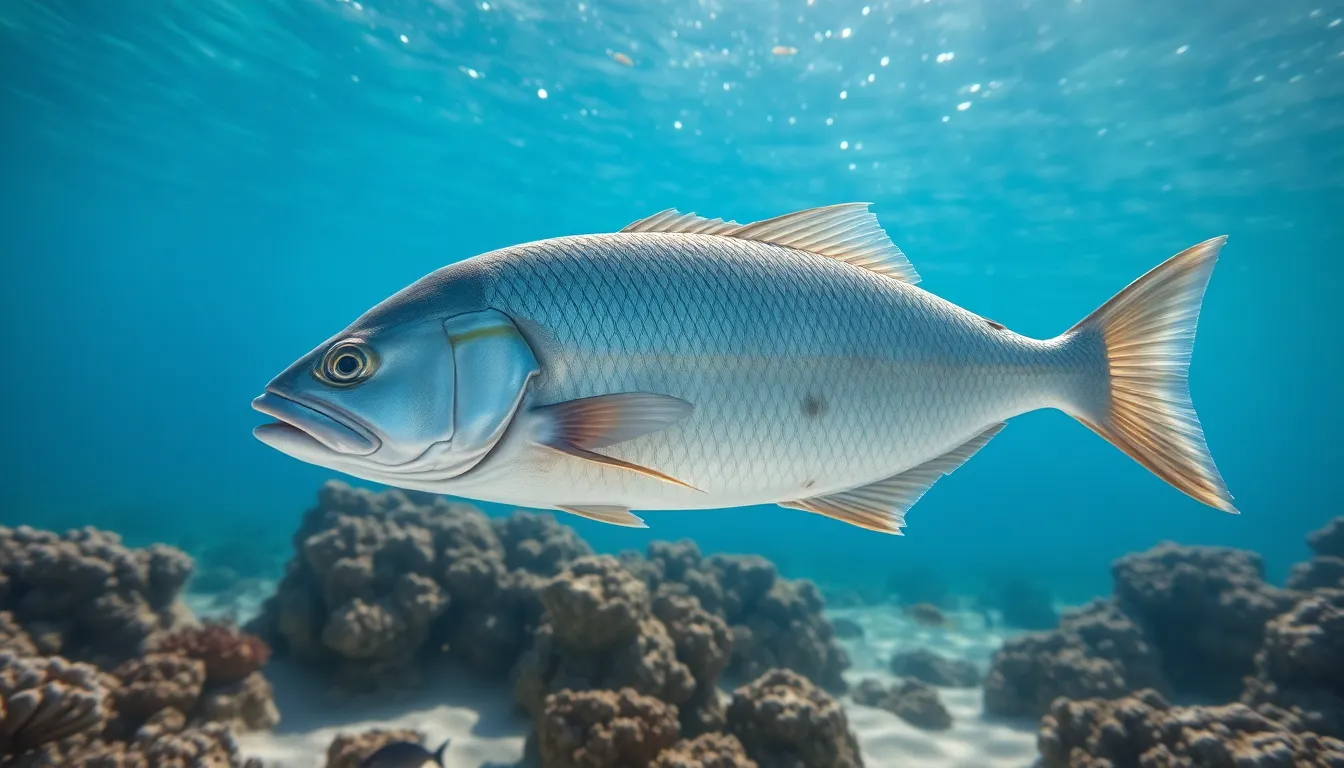
The Barramundi, scientifically known as Lates calcarifer, belongs to the family Latidae. This species is commonly referred to as the Asian sea bass, giant perch, or simply “barra” in various regions. The name “Barramundi” comes from an Aboriginal word, which translates to “large scale fish.” This fish is highly regarded for its culinary value and is a popular target for spearfishing enthusiasts worldwide.
Physical Description and Identification Markers
The Barramundi exhibits a streamlined body with a distinctive silver coloration that can range from greenish to bluish hues on the back. The belly is typically white, and as the fish matures, it develops a notable dark spot near the base of the pectoral fin. Adult Barramundi have a large, forked tail and can be identified by their long dorsal fin, which is divided into two parts. Young Barramundi often possess darker vertical stripes along their bodies, which fade as they grow.
- Body Shape: Streamlined, elongated body.
- Coloration: Silvery with a greenish or bluish back and a white belly.
- Dorsal Fin: Long, divided dorsal fin.
- Identification Markers: Dark spot near pectoral fin, vertical stripes in juveniles.
Size Ranges and Record Specimens
Barramundi can grow to impressive sizes, with adults typically reaching lengths of 60 to 100 centimeters (24 to 39 inches) and weights of 30 kilograms (66 pounds) or more. The largest recorded Barramundi was caught in Australia, measuring 1.8 meters (5 feet 11 inches) and weighing approximately 60 kilograms (132 pounds). It is essential for spearfishers to be aware of the size limits in their respective regions to ensure sustainable fishing practices.
Habitat Distribution and Depth Ranges
The Barramundi is native to the coastal waters of the Indo-Pacific region, inhabiting estuaries, rivers, and lagoons. They are primarily found in warm, shallow waters, typically at depths ranging from 1 to 20 meters (3 to 66 feet). Barramundi are known to migrate between freshwater and saltwater environments, which makes them highly adaptable to varying habitats.
Habitat Depth Table
| Habitat Type | Typical Depth Range (m) |
|---|---|
| Estuaries | 1 – 10 |
| Coastal Waters | 1 – 20 |
| Rivers | 1 – 5 |
| Lagoons | 1 – 15 |
Seasonal Behavior and Migration Patterns
Barramundi exhibit seasonal behavior patterns, with migration occurring primarily during spawning seasons. In warmer months, adult Barramundi move towards estuaries and rivers for spawning, while in cooler months, they may retreat to deeper offshore waters. Understanding these migration patterns is crucial for spearfishers, as they can affect the fish’s availability in certain locations.
Seasonal Behavior Patterns
- Spring (September to November): Spawning season; increased fish activity in estuaries.
- Summer (December to February): Warmer waters; Barramundi are often found near the surface.
- Autumn (March to May): Migration back to deeper waters; decreased activity.
- Winter (June to August): Fish are less active and often found at greater depths.
Spearfishing Difficulty Level and Techniques
Spearfishing for Barramundi can be moderately challenging, often rated as a level 4 on a scale of 1 to 5, where 5 indicates the highest difficulty. Their elusive nature and preference for deeper waters can make them difficult to catch. Successful spearfishing techniques involve stalking and ambushing, as Barramundi are known to be wary of divers.
Hunting Difficulty Ratings
- Difficulty Level: 4/5
- Recommended Techniques: Stalking and ambushing.
- Best Times to Hunt: Early morning and late afternoon.
Best Hunting Methods and Gear Recommendations
When targeting Barramundi, the right gear can significantly enhance your success rate. A speargun with a minimum of 75 cm length is recommended, along with a sturdy wetsuit for protection against the elements. Additionally, using a float line can help manage the catch and prevent loss.
Recommended Gear
- Speargun: Minimum 75 cm.
- Wetsuit: Appropriate thickness for local water temperatures.
- Float Line: Essential for managing catches.
- Fins: Long fins for efficient movement in water.
Culinary Applications and Preparation Methods
Barramundi is highly prized for its flaky, white flesh that has a mild flavor. It can be prepared in various ways, including grilling, baking, frying, and steaming. Popular recipes include Barramundi fish tacos, grilled Barramundi with lemon butter, and Barramundi curry. Its versatility in the kitchen makes it a favorite among chefs and home cooks alike.
Preparation Methods
- Grilling: Best served with a marinade or seasoning.
- Baking: Ideal for retaining moisture; can be stuffed with herbs.
- Frying: Produces a crispy exterior; often served with sauces.
- Steaming: Maintains flavor and nutrients; often paired with vegetables.
Regulatory Status and Size Limits by Region
The regulatory status of Barramundi varies by region, with specific size limits established to promote sustainable fishing practices. For instance, in Australia, the minimum legal size is typically set at 58 cm (23 inches), while in other countries, regulations may differ. It is crucial for spearfishers to familiarize themselves with local regulations to ensure compliance and contribute to conservation efforts.
Conservation Status and Sustainability Notes
Currently, Barramundi is categorized as a species of least concern by the International Union for Conservation of Nature (IUCN), indicating stable populations in many areas. However, overfishing and habitat destruction pose significant threats to their sustainability. Responsible fishing practices, such as adhering to size limits and avoiding breeding grounds during spawning seasons, are essential to maintaining healthy Barramundi populations.
Conservation Status Alerts
- Current Status: Least concern (IUCN).
- Threats: Overfishing, habitat degradation.
- Recommendations: Follow local regulations, practice catch-and-release.