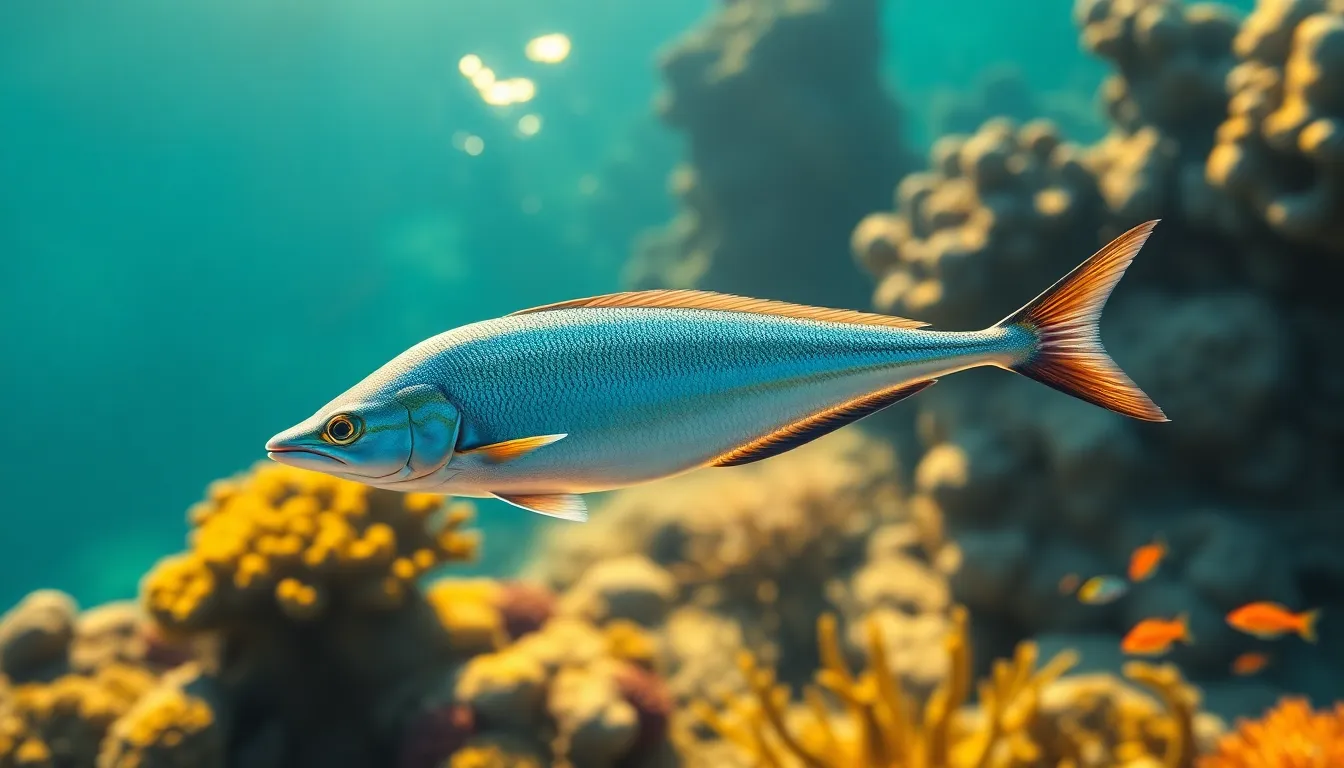
TheGreater amberjack(Lichia amia) is a fish from the Carangidae family, commonly known as greater amberjack, lemon fish, or combat fish. This species is highly valued both for its sporting value in underwater fishing and for its culinary quality. Below are its taxonomic characteristics:
- Kingdom: Animalia
- Phylum: Chordata
- Class: Actinopterygii
- Order: Carangiformes
- Family: Carangidae
- Genus: Lichia
- Species: Lichia amia
Physical description and identification markers
The Greater amberjack is easily recognizable by its elongated and aerodynamic body, designed for swimming at high speeds. Its physical characteristics include:
- Body: Fusiform and robust, with a bluish-green coloration on the top and silver on the sides.
- Scales: Small and smooth, allowing for efficient swimming.
- Dorsal fin: High and pronounced, composed of two sections; the first is spiny and the second is softer.
- Pelvic fins: Located on the underside of the body, they are short and thin.
- Eyes: Large and prominent, adapted for vision in deep waters.
Size ranges and record specimens
The size of the Greater amberjack varies considerably, reaching lengths of up to2 metersand weights that can exceed100 kg. However, the most common specimens in underwater fishing usually measure between60 and 120 cm.
Capture records have documented exceptional specimens, such as one measuring1.5 metersand80 kg, demonstrating this fish’s ability to grow and adapt in different marine habitats.
Habitat distribution and depth ranges
The Greater amberjack is primarily found in warm and temperate waters of the Atlantic, Indian, and Pacific Oceans. Its geographical distribution includes:
- Western Atlantic: From southern New England to Brazil.
- This of the Atlantic: Waters of Europe and the Mediterranean.
- Pacific: From California to Peru.
In terms of depth, the Palometón prefers waters that range between10 and 100 meters, although it has been recorded at greater depths in search of prey.
Seasonal behavior and migration patterns
The Palometón exhibits seasonal migratory behavior, moving to warmer waters during the winter. In spring and summer, they can be found in coastal areas, while in autumn, they return to deeper waters. This migration pattern is crucial for their reproduction and feeding, as they seek nutrient-rich waters.
Behavior patterns include:
- Feeding: Active during dawn and dusk.
- Reproduction: Occurs in warm waters, where they gather in large schools.
Level of difficulty in spearfishing and techniques
Spearfishing for the Palometón is consideredmoderately to highly difficult, due to its speed and agility. Fishermen must be prepared for active and strategic hunting. Some recommended techniques include:
- Waiting: Waiting in a strategic location where schools are known to pass.
- Stalking: Stealthily approaching the prey, using the environment for camouflage.
The use of anappropriate speargun, with high-precision tips, is essential for ensuring a successful catch.
Best hunting methods and equipment recommendations
For an optimal spearfishing experience, the following is recommended:
- Equipment: A speargun of 90 to 120 cm, with an easy-loading system and a tip suitable for the size of the Palometón.
- Baits: Use baits like small fish or squid to attract Palometones.
- Wetsuit and fins: A wetsuit suitable for the water temperature and long fins to enhance propulsion.
Culinary applications and preparation methods
The Palometón is known for its firm white meat, ideal for various preparations. Some of the most popular include:
- Grilled: Marinated with herbs and spices, grilled.
- Ceviche: Raw, marinated in lemon juice with onion, cilantro, and chili.
- Fillets: Cooked on the grill or in the oven, accompanied by fresh sauces.
The versatility of the Palometón in the kitchen makes it a favorite among seafood lovers.
Regulatory status and size limits by region
It is essential to know the local regulations regarding Palometón fishing, which can vary significantly by region. Some key points include:
- Size limits: Most regulations establish a minimum catch size of at least60 cm.
- Closed seasons: Some areas have closed seasons to protect populations during the breeding season.
It is advisable to consult with local fishing authorities before embarking on a hunt.
Conservation status and sustainability notes
The Almaco jack is classified as a species of moderate concern, with certain populations declining due to overfishing and habitat destruction. To contribute to the sustainability of this species, it is recommended:
- Responsible fishing practices: Respect the regulations and size limits established.
- Sustainable fishing: Opt for capture techniques that minimize harm to the population and the marine ecosystem.
The conservation of the Almaco jack and its habitat is crucial to ensure that future generations can also enjoy the underwater fishing of this magnificent species.